 SAKER
SAKER
Mini Chainsaw with Two Batteries
A small cordless saw for fence rows, fallen limbs, and the dead wood you can reach without climbing a ladder.
$51.074.5 out of 5 6,657 ratings
The bar length on our mini chainsaw is not the limb thickness it handles. Here is where the line really falls, and what happens past it.
The number people buy on is the bar, and the number that decides the afternoon is the limb. Our mini chainsaw carries a 6 inch cutting face on a 9 inch steel plate. That does not mean it takes a 6 inch limb, because the chain has to travel through the wood and come out the far side with room to spare.
In our own yard the honest figure is closer to four inches in one pass. Up to that, the saw drops through a branch in a couple of seconds and you never change your grip. Past it you are working the cut from two sides, which is fine on the odd log and tiring on a whole pile.
The whole tool weighs about 2.5 lb with the pack in it, and that weight is the point. Storm cleanup is rarely one big trunk. It is forty small branches lying at forty angles, half of them over your head, and a full size saw asks for both hands and a stance for every one of them.
A one hand saw lets you hold the branch with your other arm and cut where you are standing. That is also why we would not sell it as a felling tool. Nothing about a 6 inch bar wants a standing tree.
Pruning is the obvious one, and it is the job the saw was shaped around. Deadwood out of an apple tree, water sprouts off a maple, hedge stems too thick for shears, a fallen limb blocking the drive. Firewood counts too, as long as we are talking about bucking branches into stove lengths rather than splitting rounds.
It also comes indoors more than we expected. Pallet boards, old fence pickets, a 2x4 that needs shortening and does not deserve a trip to the garage. The chain does not care that the wood is milled.
The chain and bar are wear parts. They dull, they stretch, and they get replaced, the same way a drill bit does. Anyone expecting the first chain to last the life of the saw is going to be disappointed by a tool that is working exactly as designed.
The trigger stays dead until the lock button is pressed, so the first pull often feels like nothing happened. That is the tool waiting, not a fault. Press the lock, then squeeze, and give the chain a second to come up to speed before it touches wood.
The commonest mistake with a small saw is pushing. A chain cuts by pulling itself into the wood, and leaning on the tool mostly loads the motor and slows the chain down. Hold the saw steady, let it settle into its own line, and the cut takes care of itself.
The other habit worth building is looking at where the chain comes out, not where it goes in. Branches close on the bar as they sag and pinch the chain still, so cutting a little on the underside first gives the limb somewhere to go. On anything under tension, that first relief cut is the whole job.
We build the 6 inch saw in several forms and they cut identically. What changes is what rides along in the case. The plain version is the saw, one pack and a charger. The two battery version doubles the running time. The full kit adds spare chains and the odds and ends that otherwise get bought separately a month later.
Our advice is unexciting. If the saw is for the occasional fallen branch, the plain one is the right buy and the case will sit on a shelf most of the year. If it is going to be used through a whole pruning season, the second pack pays for itself in trips back to the charger.
One piece per family off the shelves this note covers, read from the catalog on 2026-09-10.
A small cordless saw for fence rows, fallen limbs, and the dead wood you can reach without climbing a ladder.
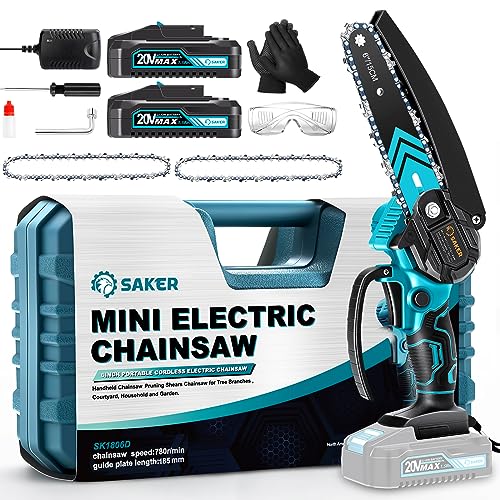
A handheld cordless saw with a quenched chain and two batteries for clearing storm debris, pruning branches, and bucking small firewood.
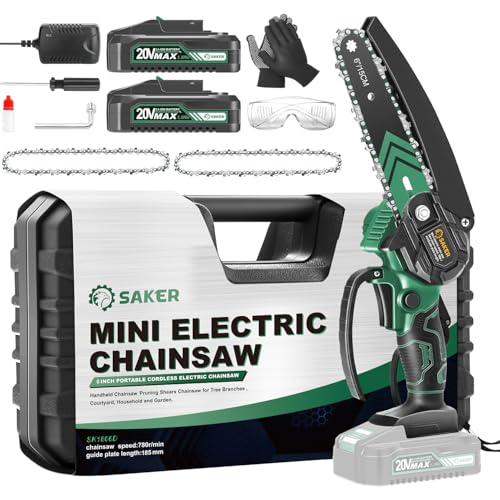
A compact cordless saw built for pruning green branches, clearing fence lines, and cutting downed limbs into firewood.
One number sets how hard a tool pulls, the other sets how long. Also the part most brands skip: our packs are not one family.
The tool that turns a door casing into a pencil line. How to press it, when to lock it, and which length to reach for.
A dull chain makes dust instead of chips and asks you to push. What the angles mean, and why touching up beats grinding.