 SAKER
SAKER
Mini Chainsaw with Two Batteries
A small cordless saw for fence rows, fallen limbs, and the dead wood you can reach without climbing a ladder.
$51.074.5 out of 5 6,657 ratings
A dull chain makes dust instead of chips and asks you to push. What the angles mean, and why touching up beats grinding.
A sharp chain throws chips. Little curls of wood come out of the cut and pile up under the branch, and the saw pulls itself down without help. A dull chain throws dust. The pile turns powdery, the cut slows, and you start leaning on the tool to keep it moving.
That leaning is the real cost. A blunt chain is doing less work while you do more, the motor runs hotter for a longer cut, and the pack empties faster for fewer branches. When the chips turn to dust, the chain is telling you the job is now sharpening.
Our sharpener carries an angle attachment with presets at 35, 30 and 25 degrees, and the number is the angle the cutting edge meets the wood. Softer, greener wood likes a more aggressive edge. Harder and dirtier wood likes a shallower one that holds up longer.
The practical advice is to find out what your chain came ground at and keep it there. Consistency matters more than picking the theoretically best number, because every tooth on the chain has to match every other tooth. Mixed angles make a chain that pulls to one side.
The kit runs from 5000 up to 30000 RPM across five steps, and most touch ups belong at the low end. A chain that is slightly dull needs a few passes to bring the edge back, and slow speed with light pressure takes off exactly that much.
Fast speed and a heavy hand remove far more steel than the edge needed, and the chain gets shorter in life every time. We would rather someone touch up a chain after every second or third session than grind a wrecked one back once a year.
The sharpener arrives with 126 accessories, which sounds like packaging until the chain is done and the tool is still in your hand. Underneath the angle attachment it is a cordless rotary tool on a 2000mAh pack, and the rest of the box is cutting discs, sanding drums, polishing wheels and engraving bits.
That is worth knowing before it goes back in the drawer. Rust off a hinge, a burr off a cut bolt, a scratch polished out of a bracket, a name into a garden tool. The chain is the reason to buy it and rarely the last thing it does.
Every tooth on a chain has to come back the same amount, or the long ones do all the cutting and the chain pulls to one side. The way to get that is not judgement, it is counting. Decide on a number of passes for the first tooth, then give every other tooth exactly that number.
Mark your starting tooth with a felt pen so you know where the lap ends. Work one side of the chain all the way round, then turn the saw and do the other side. Chains alternate direction tooth by tooth, and doing them in two passes is what keeps the count honest.
Almost nothing about clean timber blunts a chain quickly. Grit does. A branch dragged across a driveway, a log that has been lying in soil, a stump cut low enough to touch dirt: any of those take an edge off in a few seconds that an afternoon of clean cutting would not.
So the cheapest sharpening habit is not sharpening. Cut branches before they hit the ground where you can, brush soil off a log before bucking it, and keep the bar out of the last inch above dirt. A chain that never meets grit stays sharp for a surprisingly long time.
One piece per family off the shelves this note covers, read from the catalog on 2026-09-10.
A small cordless saw for fence rows, fallen limbs, and the dead wood you can reach without climbing a ladder.
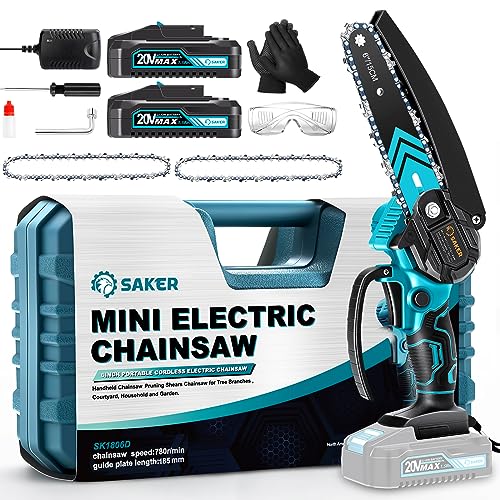
A handheld cordless saw with a quenched chain and two batteries for clearing storm debris, pruning branches, and bucking small firewood.
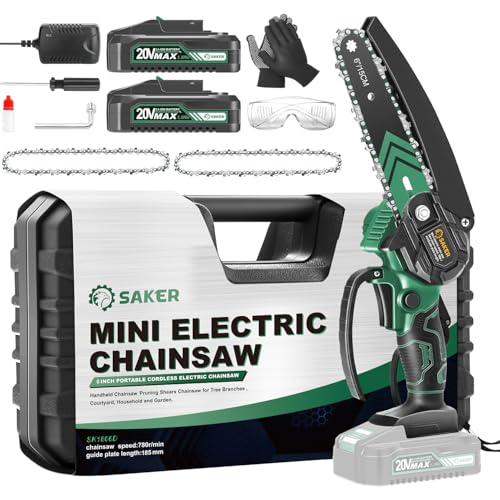
A compact cordless saw built for pruning green branches, clearing fence lines, and cutting downed limbs into firewood.
The bar length on our mini chainsaw is not the limb thickness it handles. Here is where the line really falls, and what happens past it.
One number sets how hard a tool pulls, the other sets how long. Also the part most brands skip: our packs are not one family.
The tool that turns a door casing into a pencil line. How to press it, when to lock it, and which length to reach for.